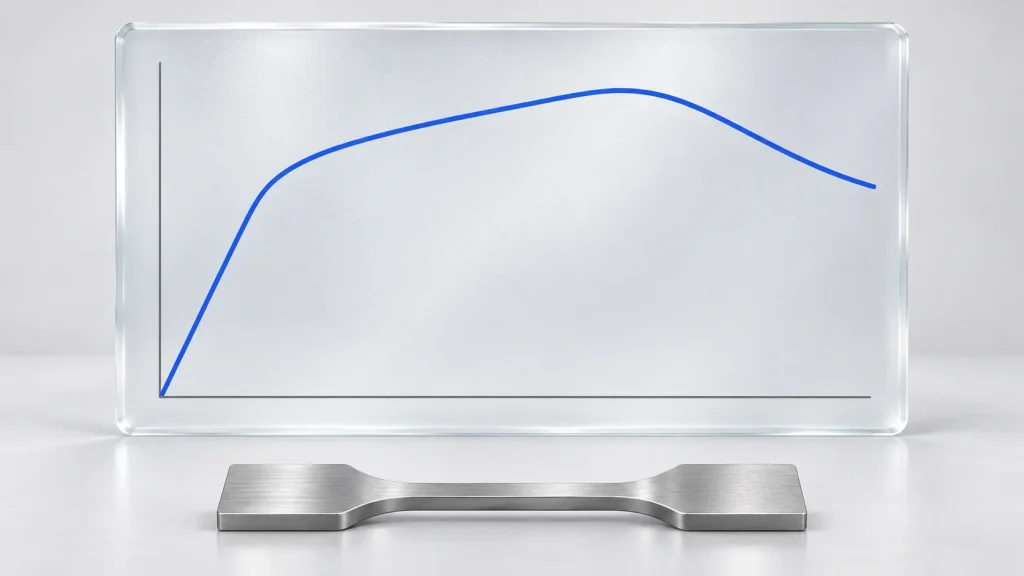
A tensile report may contain results in N, MPa and %. These are not three ways of writing the same result. They answer different questions: how much load was carried, how that load relates to the original area, and how much a measured length increased relative to its starting length.
Force and stress: the area connects them
Tensile force F is a force, commonly reported in N or kN. The SI unit of stress is Pa; engineering reports often use MPa. Unit conversion gives 1 MPa = 1 N/mm². A value in N cannot be converted into MPa without an area. [1]
Engineering stress uses the initial cross-sectional area A₀: σ = F/A₀. Engineering strain uses the initial gauge length L₀: ε = ΔL/L₀. The first calculation normalizes load by area; the second normalizes extension by length. A₀ is not the changing local area during stretching. Using a current area would change the stress definition, so the two calculations should not be mixed. [2]
Tensile strength is not automatically the fracture point
For metallic materials, tensile strength is commonly expressed as Rm = Fm/A₀, where Fm is the maximum force identified according to the test method. Tensile strength, force at fracture and yield properties are different results, and their evaluation points need not coincide. Material-specific methods can also define different strength evaluation points. An arbitrary highest spike in the data should therefore not automatically be labelled tensile strength. [3]
Elongation needs a defined measurement length
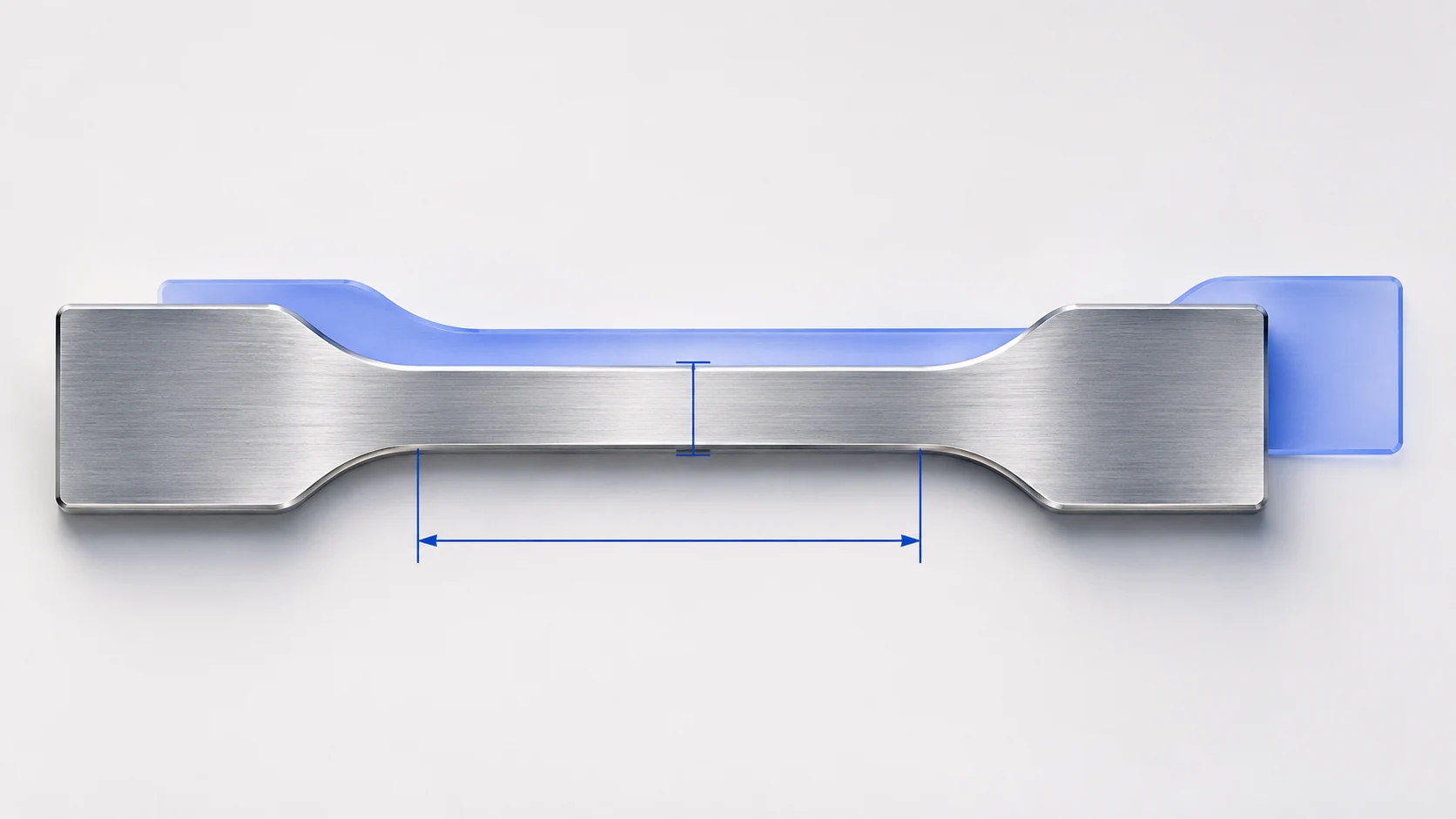
Extension ΔL is a change in length, often measured in mm. The ratio ΔL/L₀ has no dimension and becomes a percentage when multiplied by 100%. Gauge length is the part of the specimen over which extension is measured. Its definition depends on the method and measurement device; it is not necessarily the specimen’s overall length or the distance between grips. Equal extensions in millimetres give different percentages if the initial gauge lengths differ. [4]
The measurement stage also matters. For metals, percentage elongation after fracture describes permanent extension relative to L₀. Total extension recorded continuously up to fracture is a different quantity. [5] Rejoining the broken specimen pieces and measuring afterwards is a different procedure from reading an extensometer at fracture. A report should identify which result it contains rather than leaving an unexplained percentage labelled only “elongation.” [6]
Four checks before comparing reports
- Result and unit: is the value maximum force, tensile strength, a yield property or elongation?
- Geometry: are the original area, specimen shape and gauge length comparable?
- Measurement: which part of the specimen was measured, and was the result obtained during the test or afterwards?
- Method: which standard, edition and test conditions were used?
This checklist helps structure a technical discussion; it does not make unlike tests equivalent. ASTM’s public guidance also cautions that results from standardized specimens may not fully represent an entire finished product or its behaviour in different service environments. [7]
This article explains basic concepts. Perform specific tests using the applicable standards and methods.